
FiMA4 + The Space Between: “SOLIDARITY!”
University of North Carolina, Greensboro | May 26 – 29, 2026
Solidarity! A joint conference of the Space Between Society and the Feminist inter/Modernist Association (FiMA)
Registration Now Open! Due May 1, 2026
Registration includes:
- Space Between membership
- FiMA membership, which also includes print and digital access to Feminist Modernist Studies.
- Conference Registration
- Business Lunch + Reception
Rates:
$160 — graduate students
$185 — contingent faculty, emeritus faculty, independent scholars
$210 — full-time faculty
Proposals Due: February 5, 2026
Send to feministintermodernist@gmail.com. Please note, all conference-related inquiries should be directed to Ben Clarke b_clarke@uncg.edu.
Greensboro, North Carolina, the host city for this year’s joint conference, is geographically, culturally, and historically a space between. Known as “Gate City” because of its key position on the rail network, it is not only a midpoint between the state capital, Raleigh, and North Carolina’s biggest city, Charlotte, but also an entrance to the South. At once an integral part of the region and open to the broader world, it has long exemplified the solidarities as well as the divisions that have marked the United States in the nineteenth and twentieth centuries. It is not only the site of the 1979 Greensboro Massacre, in which members of the Ku Klux Klan and neo-Nazis killed five Communist demonstrators, but of the Woolworth lunch counter protests, a pivotal moment in the Civil Rights movement. These episodes demonstrate the complexities of the city’s history, which includes examples of oppression and resistance, division and solidarity, as well as the ability of political organization and activism to challenge systemic injustice.
The host institution, the University of North Carolina, Greensboro, embodies the contemporary city. Opened in 1892, it was for many years a women’s college and is one of the most diverse institutions in the state. 66% of current students are female, 56% are people of color, and 52% of undergraduates are first-generation. The university is ranked by US News and World Report first in North Carolina and thirteenth in the country for social mobility. It has a long-standing commitment to the arts and humanities, demonstrated in everything from its MFA in Creative Writing, one of the oldest such programs; to its summer music camp, the largest in America; to the Weatherspoon Art Museum, which has work by figures including Willem de Kooning and Henri Matisse in its permanent collection. The university’s emphasis on difference as a source of strength rather than division makes it a particularly fitting site for this year’s conference.
We invite proposals for “Solidarity!,” a joint multidisciplinary conference co-hosted by the Space Between: Literature and Culture, 1914-1945 and the Feminist inter/Modernist Association. Proposals should explore solidarity across the interwar era. From wartime alliances and antifascist fronts to labor internationals, colonial and anti-colonial coalitions, mutual aid networks, and faith- or community-based forms of care, 1914–1945 witnessed intense experimentation with how people stand together across borders, classes, races, and ideologies. We welcome historical, literary, cultural, political, and theoretical approaches that illuminate how solidarity was imagined, organized, represented, contested, and lived.
Proposals could engage with but are not limited to topics such as:
- Archival gate-keeping and literary afterlives
- Community building
- Civility
- Civil Discourse
- Civil Disobedience
- Civil War
- 100th anniversary of the UK General Strike
- Bodily solidarity: Health, reproduction, contraception, dis/ability, surveillance, imprisonment, technology, pleasure
- Union leading, governance, and busting
- Women’s clubs/groups and building intergenerational solidarity
- Groups and non-groups (organized and unorganized solidarity)
- Media Ecologies: photography, film, radio, documentary, periodicals, visual and plastic arts
- Holocaust Studies
- Urban, suburban, rural collectivity
- Solidarity and the use of space
- Queer and Trans Counterpublics
- Mutual Aid and Community Care
- Underground Resistance
- Teaching solidarity/solidarity in the classroom
- Feminist modernist solidarity in the age of polarization
- Solidarity across/with ethnic and linguistic minorities
- Cross-class solidarity
- Solidarity by/through design
- Violence, solidarity, and resistance
Part of SB’s and FiMA’s mission is to mentor and support graduate students at any level in their professionalization. We encourage graduate students to propose individual papers and full panels with fellow graduate students and/or faculty mentors. Please note, this year, the selection committee will be nominating graduate student proposals for our “Emergent Voices” Graduate Student Plenary Session. Graduate students chosen for this session will be mentored and offered the opportunity for a practice panel session pre-conference. If you are a graduate student and would be interested in being considered for this session, please indicate so on your individual proposal.
Individual proposals should be 250-300 words and include a working title. Please also include a short bio.
Panel proposals (3-4 participants) should be no more than 600 words and include a panel title and working titles. Please also include short bios for each participant.
Workshops proposals for any workshops related to mentorship, scholarship, or teaching should be 200 words and include proposed title and leaders with bios.
A note on period: Because we recognize that writers, artists, and culture makers did not simply stop their work at the close of 1945, topics may move outside the range of 1914-1945 as long as the link to the Space Between is manifest.
Proposals for panels, individual papers, and workshops are due January 15, 2026 and should be sent to feministintermodernist@gmail.com by February 5, 2026. Please note, all conference-related inquiries should be directed to Ben Clarke b_clarke@uncg.edu.
Past Conferences
FiMA3: “Feminist Provocations”
University of Mississippi, Oxford, MS | May 16-18, 2024
The 2024 conference of the Feminist inter/Modernist Association (FiMA) celebrates and
problematizes modernism as a cultural provocation. At times obnoxious and difficult,
erudite and primitive, modernist art works and cultural forms are nothing if not provoking
in their apparently cavalier dismissal of conventional aesthetic, sexual, and cultural
standards. This trolling of conventional middle-class patrons of the arts extended to
conspicuous violations of gender and sexual norms, from Josephine Baker’s cabaret
performances to the gender-bending Eton cut that Laura Doan details in Fashioning
Sapphism to the performative fashion and art of provocateurs like the Baroness Elsa
von Freitag-Loringhoven, Katherine Dunham, Claude Cahun, and Marcel Moore. The
sexual liberation claimed by writers like Djuna Barnes and Radcliffe Hall, and the calling
out of racism and colonialism by writers like Una Marson, Jean Rhys, and Rebecca
West, also provoked and unsettled the patriarchal and imperial establishment, some
well into the postwar years.
We invite explorations of feminist modernism’s many provocations across poetry, fiction,
drama, periodicals, music, art, photography, craft, performance, fashion, and dance. We
encourage feminist examinations of little magazines, slick magazines, independent
presses, and transnational networks and circulations. We seek reconsiderations of the
feminist uses of space and place inside and out of established cultural venues (pop-up
lectures, public events, and street performances). We invite expansive investigations of
multiple modernisms, especially those centering intersectional analyses including race,
class, colonialism, sexuality, genders, geographies, and cultural hierarchies, and we
encourage proposals that stretch the boundaries of “modernism,” in period (1870-1970),
genre, style, and discipline.
We invite individual paper, panel, or roundtable proposals that engage with Provocative
and/or Provoking Literary, Artistic, Performative, and other Cultural Forms situated
between 1870-1970, such as:
- Sexual provocations and liberation
- “Bad” feminist provocations, both artistically and politically
- Feminist demands of radicality and revolution
- Black art forms’ movement from margin to center
- Climate, Ecology, and the Anthropocene
- Embodied provocations: health, reproduction, contraception, dis/ability,
surveillance, imprisonment, technology, pleasure - Agent provocateurs: fighting fascism, racism, and cruel capitalism
- Provocative media: photography, film, radio, documentary, visual and plastic arts
- Provocative collaborations: friendships, intersectional alliances, organizations
- Provoking women: spinsters, witches, lesbians, elders
- Provoking affects: anger, rage, irritation, anxiety, animatedness
- Provoking the historical record: Archiving women/women as archivists
- Provoking literary estates: Archival gate-keeping and literary afterlives
- Provoking cultural institutions and their arbiters
- Feminist modernist provocations: revising high modernism in light of “Me Too” and Black Lives Matter
Part of FiMA’s mission is to mentor and support graduate students at any level in their
professionalization. FiMA encourages graduate students to propose individual papers
and full panels with fellow graduate students and/or faculty mentors. Please note, this
year, the selection committee will be nominating graduate student proposals for our
“Emergent Voices” Graduate Student Plenary Session. Graduate students chosen
for this session will be mentored and offered the opportunity for a practice panel session
pre-conference. If you are a graduate student and would be interested in being
considered for this session, please indicate so on your individul proposal.
Individual proposals should be 250-300 words and include a working title. Please also
include a short bio.
Panel proposals (3-4 participants) should be no more than 600 words and include a
panel title and working titles. Please also include short bios for each participant.
Rather than reading short papers and running out of time, participants on FiMA
Roundtables (5-6 participants) should provoke conversation about a particular topic
and include room for generative audience participation. Proposals should be no more
than 600 words and include a description of the scope of the roundtable conversation
and short bios for each participant.
FiMA2: “Feminist Revolutions” (the second Feminist inter/Modernist Association Conference, was canceled due to Covid).
Good news: we turned many of the papers that were to be presented at FiMA2 into articles. The special edition of Feminist Modernist Studies 6.1, “Feminist Publishing Against the Pandemic” was published in March 2023. Click the button below to view and read the issue.
FiMA1 2018: “Intersections of Resistance”
20th Annual Conference of the Space Between Society Inaugural Conference of the Feminist inter/Modernist Association
June 7-9, 2018 University of Northern Colorado
#sbresist18 #FiMA18
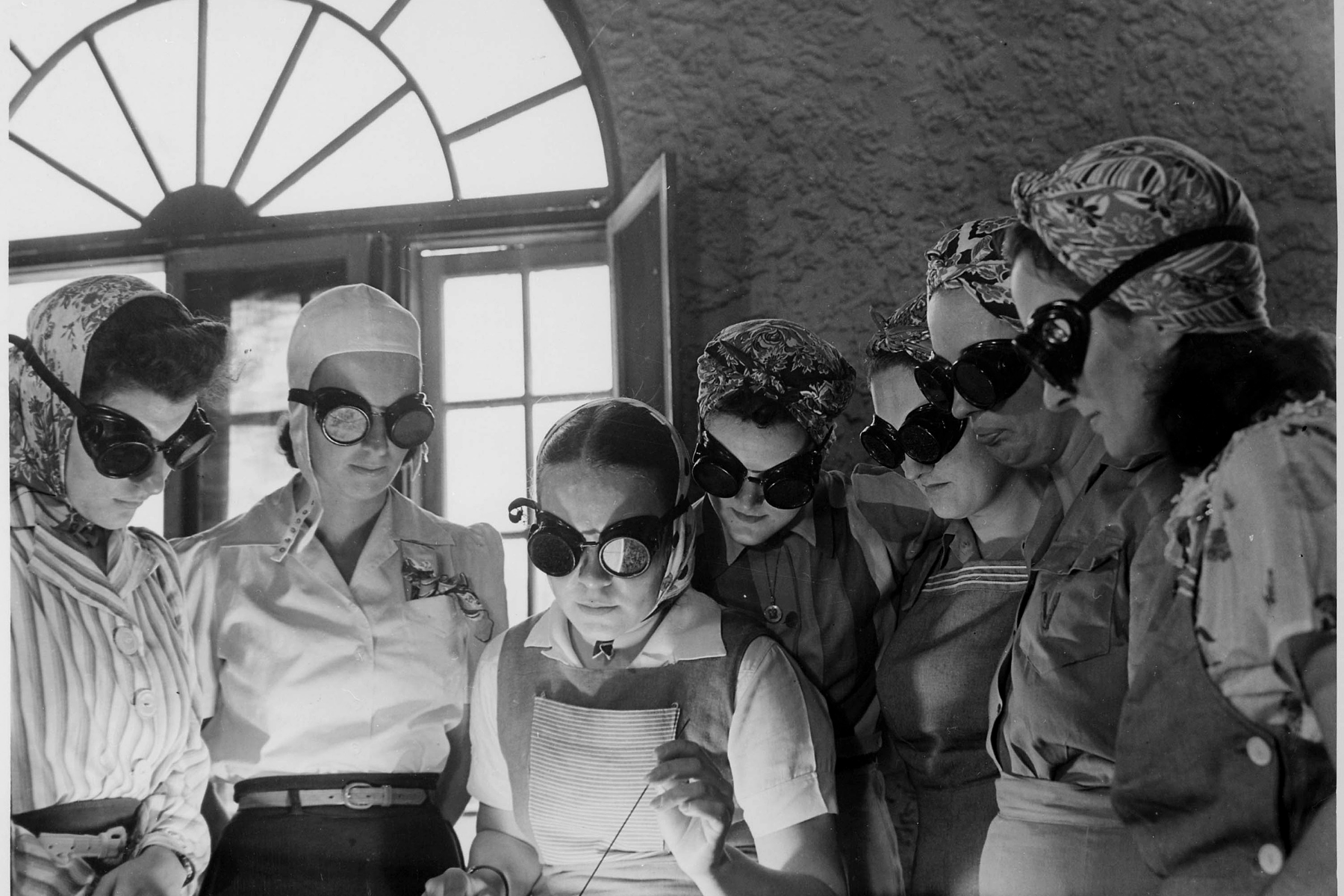
Photo Credit: “Secretaries, housewives, waitresses, women from all over central Florida are getting into vocational schools to learn war work. Typical are these in the Daytona Beach branch of the Volusia county vocational school” (April 1943) via US National Archives
Feminist Modernist Studies

 Feminist inter/Modernist Association